The End of Free WhatsApp: What Meta Announced and How to Avoid the Full Bill
Starting October 2026, Meta will charge for almost every reply message on WhatsApp Business — free today. We explain what changes, what it could cost, and how Zapify's omnichannel orchestration cuts that impact without retreating from your Conversational Marketing strategy.
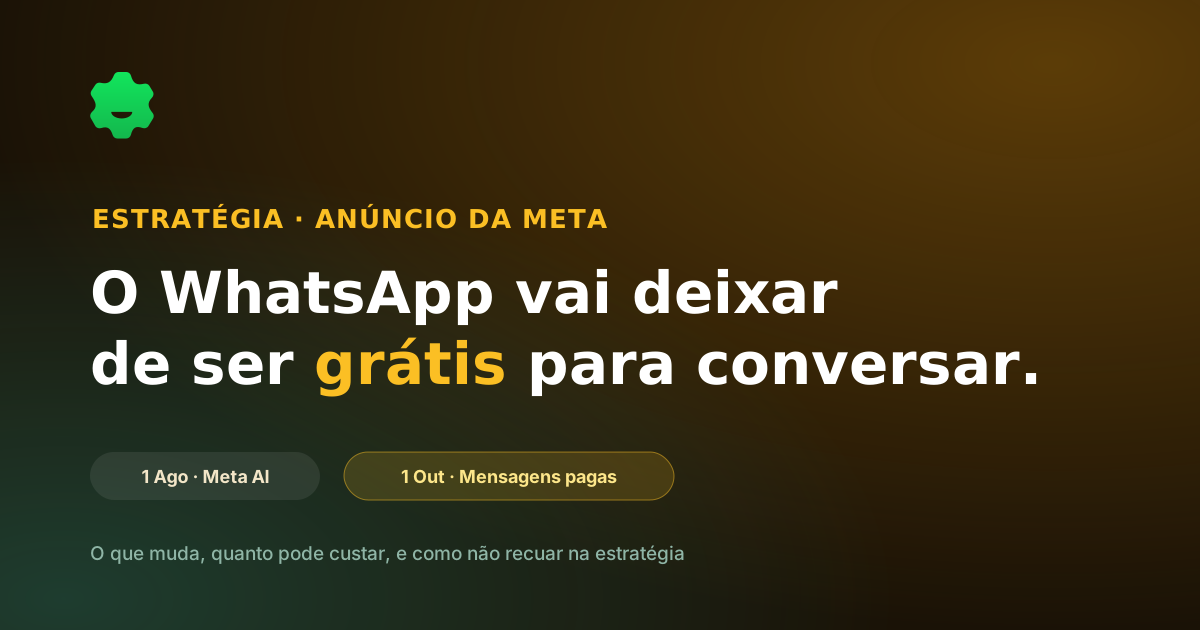
On July 1, 2026, Meta announced sweeping changes to WhatsApp Business Platform pricing. Starting October 1, 2026, almost every reply message sent to a customer — free today — will be billed per message. This isn't fine print: it's the end of one of the last truly free zones on the channel most used for customer conversations across Europe.
In this article, we explain in plain English exactly what changes, the full timeline, what it could mean in euros per month, and — most importantly — how an omnichannel Conversational Marketing strategy turns this announcement from a threat into a competitive edge.
Three dates, one clear direction
None of these get reversed — the direction is always the same: less free, more billed per message.
Jul 1, 2026
Meta Business Agent launches
Meta launches its own AI agent platform for WhatsApp — a direct competitor to your assistant, built right into Meta.
Aug 1, 2026
Per-token billing (Meta Business Agent)
Anyone using Meta's own agent starts paying per token — prompt and response — roughly 4–5 cents per complex message.
Oct 1, 2026
Service and utility messages become billable
Every reply — human or third-party AI — stops being free. This is the date that matters to almost every business.
It's free today. From October 1, it won't be.
Campaign templates don't change — they were always paid. What changes is everything else: the day-to-day conversation.
| Message type | Today | From Oct 1, 2026 |
|---|---|---|
| Marketing template | Paid | Paid (unchanged) |
| Authentication template | Paid | Paid (unchanged) |
| Utility template — outside the window | Paid | Paid (unchanged) |
| Utility template — inside the 24h window | Free | Paid |
| Human or third-party AI reply ("service") | Free | Paid |
| Reply inside the 72h free window (Click-to-WhatsApp ads) | Free | Free (unchanged) |
We simulated the impact on our own client portfolio
We applied the new rules to a real, closed month of traffic — no third-party estimates, using the actual message volume that flowed through. The conclusion is direct: on higher-volume accounts, the impact of messages that are free today easily runs into the thousands of euros per month — and that exposure is heavily concentrated among businesses using WhatsApp as their only conversation channel, with no deflection lever at all.
On accounts that already used Flows for structured processes (bookings, lists, confirmations), the same simulation shows a much smaller share of volume classified as "billable free-form reply" — the difference between the two realities is precisely the orchestration of the right channel for each type of conversation.
Three levers that only exist because we're omnichannel
None of them ask you to retreat from WhatsApp — they ask you to use it where it's irreplaceable, and deflect the rest. A typical 8-reply conversation, deflected to Webchat after the 2nd exchange, can cut billable WhatsApp messages by up to 87.5%.
WhatsApp Flows instead of back-and-forth questions
A booking, a check-up, a shopping list — today that's 5, 10, 15 messages back and forth. A Flow solves the same thing in screens inside the conversation itself and only generates 1 billable message: the final reply.
Deflect the long conversation to Webchat
A question, a recipe, a clarification — none of that needs to happen inside WhatsApp. One message with a link opens your website's webchat and the conversation continues with the same context, with zero Meta message cost.
Voice calls for what's really a conversation
For longer support needs, a call (AI-powered or human) solves the same problem without generating billable WhatsApp messages — an additional lever, not the first one to reach for.
We charge per conversation. Meta charges per message.
The Meta Business Agent charges between $0.04 and $0.05 for every message the AI generates — prompt and reply, every single time. Zapify charges a single initiation fee per conversation, which covers the entire back-and-forth within the same 24-hour window — even counting the service-message fee Meta will charge starting in October.
In a conversation with 8 AI replies, the Meta Business Agent costs around $0.40. The same conversation on Zapify, even at our base rate with no volume package, costs €0.37. On higher-volume packages, the advantage shows up as early as the 3rd reply.
Meta makes more money when your business sends more messages. Zapify creates more value when it resolves more conversations for less.
The same conversation, without paying Meta for all of it
A customer asks something with no quick end — instead of piling up billable messages, the conversation moves to the website's own webchat, with the same history.
LINHA
WhatsApp — opens the bridge
LINHA — Apoio ao Cliente
Continuing the conversation
Webchat — resolves with no per-message cost
You don't need to retreat from Conversational Marketing to contain the cost.
You need to orchestrate the channels — so Meta decides the price of a message, not your company's strategy.
What to measure now, before the invoice lands
- How many conversations you get per month, and how many replies each one takes.
- Which of those replies really need to happen inside WhatsApp.
- What your AI costs today per interaction, message by message.
- How much you could save by deflecting longer conversations to Webchat.
Frequently asked questions about WhatsApp's new pricing
Does this only apply to businesses using Meta's own AI agent?
No — that's only the part already in effect since August 1. Starting October 1, 2026, billing covers ALL non-template replies: human, third-party AI assistants (like Zapify's), and utility templates answered inside the 24-hour window.
Will Zapify charge me more because of this?
The cost itself is billed by Meta to whoever sends the message, not by Zapify — but businesses running WhatsApp through a single-channel provider feel the impact across their entire volume. That's exactly the impact the levers in this article (Flows, Webchat, Voice, and our own pricing model) help reduce, without giving up on Conversational Marketing.
When will we know the exact rate?
Meta only publishes the final October rates by September 1, 2026. What's already certain is the structure: service messages will be billed at the same rate as utility messages in each market.
Is this specific to WhatsApp, or does it affect other channels?
It's specific to the WhatsApp Business Platform. That's exactly why a strategy backed by several channels — webchat, Instagram, Facebook, voice — cushions the impact: WhatsApp stays a central channel, but stops being the only cost stress point.
Can Meta tell whether a reply was written by a person or an AI?
It doesn't need to. If the message is sent by the Meta Business Agent, the per-token rate applies. If it's sent through your normal integration — whether by a human operator or a third-party AI like Zapify's — the normal message-category rate applies.
Does Zapify replace WhatsApp?
No. Zapify uses WhatsApp where it delivers the most value, and deflects the conversation to other channels when that cuts cost or improves the experience. The goal isn't to abandon WhatsApp — it's to stop depending on it exclusively.
Also read: Omnichannel Conversational Marketing: the Same Campaign, Every Channel